
Gamma Flip Lines and Call Walls: The Operating Map Behind the Tape
Gamma flip lines and call walls are not magic levels. They are areas where dealer positioning can change the character, speed, and pressure of price.
Gamma is often explained in a way that makes traders feel like they need a quant desk before they can use it. They do not.
For day trading, the practical question is simple: is the options market likely to dampen movement, amplify movement, or anchor price around a major positioning level?
Gamma flip lines and call walls help answer that question.
The gamma flip is a regime line
A gamma flip line marks the area where dealer hedging behavior can shift from stabilizing to destabilizing. Above or below that area, the same price action can behave differently.
In a stabilizing regime, moves often get absorbed. Breakouts need more proof. Fades can work cleaner when price stretches into volatility boundaries. In a destabilizing regime, movement can accelerate faster than the chart alone suggests. Breakdowns and breakouts have more room to run because hedging flows can add pressure instead of absorbing it.
Call walls are not just resistance
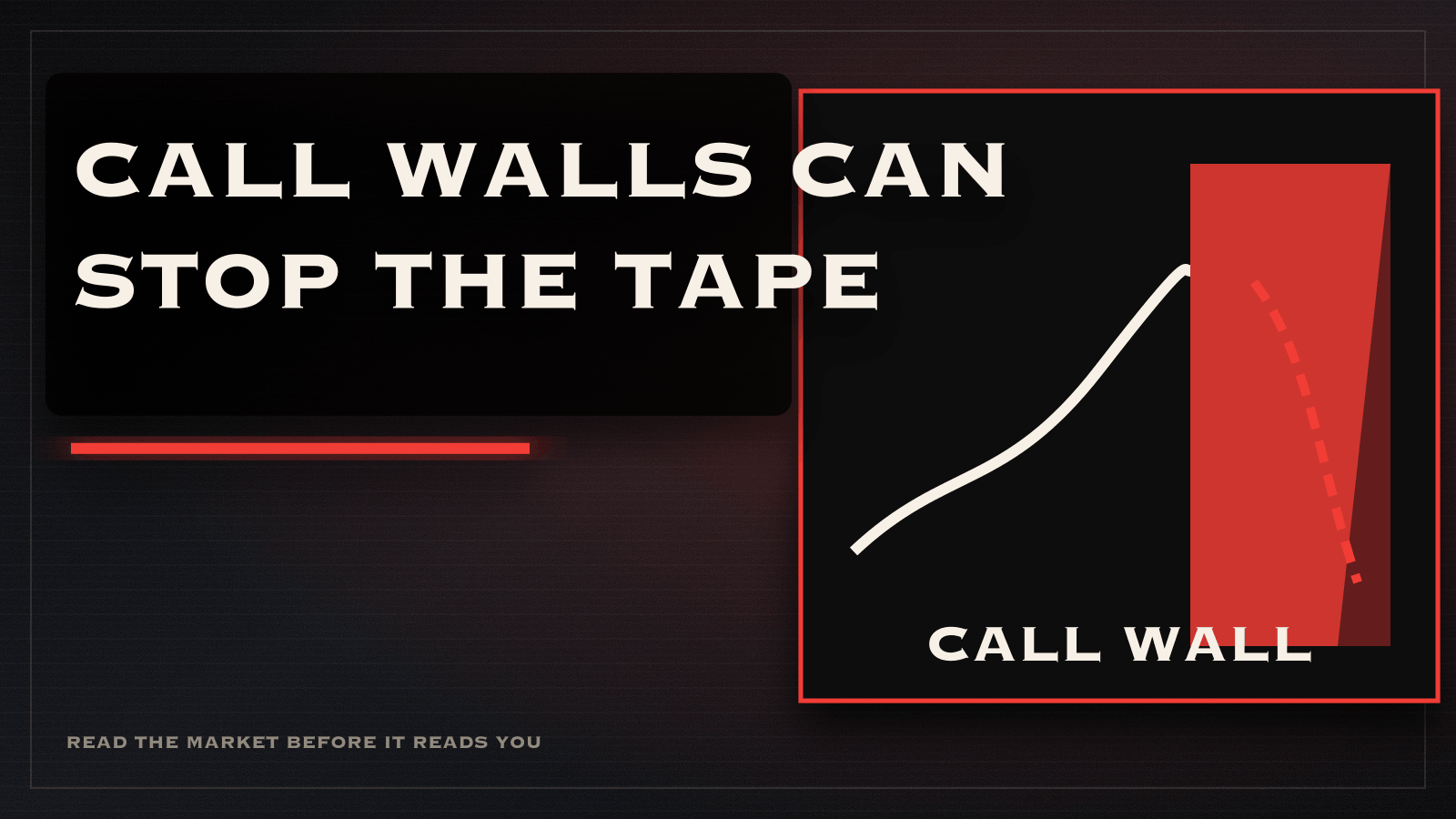
A call wall is often treated like a ceiling. That is too simple.
A major call wall can act like resistance, but it can also act like a magnet, a pinning zone, or a launch point if price accepts beyond it. The behavior around the wall matters more than the label. Does price reject quickly? Does it stall and compress? Does it break, hold, and force repositioning?
That difference changes the trade plan.
Why this belongs beside expected move
Expected move tells us the market’s volatility budget. Gamma context tells us how movement may behave inside or outside that budget. A price stretch into the upper expected move is one thing. A price stretch into the upper expected move while sitting below a major call wall and above the gamma flip is a very different thing.
The first is a level. The second is a map.
The PonoTrading approach
We do not use gamma levels as blind buy or sell signals. We use them as behavioral context. They help us decide when a move deserves patience, when it deserves skepticism, and when the market may be transitioning from rotation to expansion.
That is the difference between trading a line and reading a regime.
Continue the prep inside PonoTrading
The article is the framework. The work happens when you bring it into your daily prep, review, and execution process.
Continue the work
Get the next market note in your inbox.
Subscribe free for new Market Desk articles, then join the PonoTrading Prep Room when you are ready to bring the work into the daily flow.
Enter the Free Prep Room